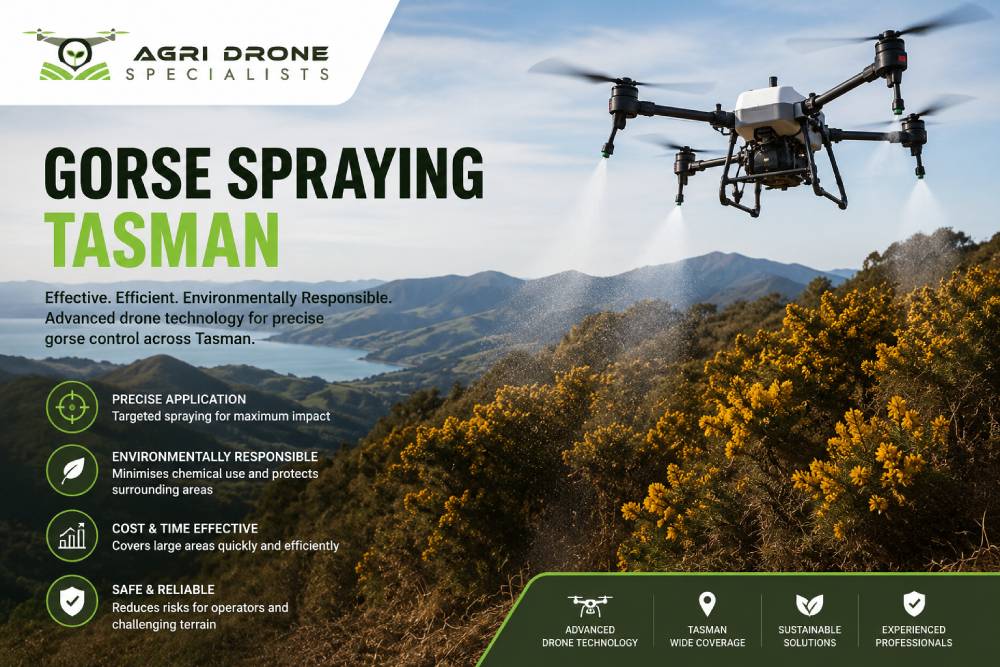

Gorse remains one of the most challenging invasive weeds across the Tasman region, affecting farms, forestry plantations, lifestyle blocks, and conservation land. Once established, it spreads rapidly, forms dense thorny thickets, and competes aggressively with desirable vegetation. Managing large infestations using conventional techniques can be costly, labour-intensive, and difficult, particularly in hard-to-reach locations.
Today, Gorse Spraying Tasman services are embracing advanced drone technology to improve the efficiency of weed control. With precision aerial application, Tasman Drone Spraying provides landowners with a modern solution that delivers accurate herbicide coverage while reducing the challenges associated with traditional ground-based methods.
The Impact of Gorse on Rural Properties
Although gorse was originally introduced as a hedge plant, it has become one of New Zealand’s most troublesome weeds. If not controlled early, it spreads quickly through seed dispersal and can dominate productive land.
Common problems associated with gorse include:
• Reduced grazing capacity and pasture quality
• Competition with newly planted forestry and native vegetation
• Obstructed access across rural properties
• Increased fire hazards during warmer months
• Higher maintenance costs over time
Because mature gorse plants produce thousands of seeds that can remain viable for years, ongoing management is essential to prevent recurring infestations.
A New Generation of Weed Management
Conventional gorse control often involves manual clearing, backpack spraying, tractors, or heavy machinery. While these methods still have their place, they are not always practical on steep slopes, gullies, riverbanks, or remote areas where vehicle access is limited.
Drone spraying has transformed the way landowners approach weed management by providing safe aerial access to locations that are difficult or dangerous to reach on foot.
Professional operators utilise high-capacity agricultural drones carrying up to 100 litres of spray mixture. Combined with high water application rates, slow flight speeds, and powerful rotor downwash, the spray penetrates deep into dense gorse bushes, helping achieve excellent saturation and highly effective weed control.
How Agricultural Drones Treat Gorse
Modern spraying drones are equipped with RTK positioning systems, automated flight planning, and precision spray equipment. Before treatment begins, the target area is carefully mapped to create an accurate flight path.
During operation, the drone flies at a consistent height while applying herbicide only where required. The controlled flight pattern ensures even coverage across the infestation while reducing unnecessary spraying of surrounding vegetation.
This technology allows difficult terrain to be treated without damaging the landscape or placing workers in hazardous conditions.
Benefits of Drone-Based Gorse Spraying
Reaches Difficult Locations
Steep hills, valleys, forestry blocks, and inaccessible rural properties can all be treated efficiently without requiring heavy machinery or extensive manual labour.
High-Quality Spray Coverage
Using generous water rates together with strong rotor downwash allows the spray to penetrate thick gorse growth, increasing herbicide contact throughout the plant.
Faster Property Treatment
Agricultural drones can efficiently cover large areas, helping landowners respond before infestations spread further across their properties.
Protects the Land
Since drones operate entirely from the air, there is no soil compaction, rutting, or damage to pasture caused by vehicles travelling across paddocks.
Safer Operations
Removing operators from steep or hazardous terrain significantly reduces workplace risks while improving overall spraying efficiency.
Precise Herbicide Placement
Advanced navigation systems help ensure herbicides are applied accurately, reducing overspray and supporting environmentally responsible weed management.
Why Drone Spraying Is Growing Across Tasman
Tasman’s diverse landscape includes rolling farmland, forestry estates, hill country, vineyards, and lifestyle properties. Many of these environments present access challenges that limit the effectiveness of conventional spraying equipment.
Drone technology provides a practical alternative by allowing infestations to be treated quickly without the need for extensive ground access. This makes it particularly valuable for property owners looking to improve productivity while protecting environmentally sensitive areas.
As agricultural drone technology continues to evolve, more landowners are recognising its ability to reduce labour requirements, improve treatment accuracy, and support long-term vegetation management.
Selecting an Experienced Drone Spraying Provider
Successful gorse control depends on more than simply applying herbicide. Effective results require careful assessment of infestation levels, appropriate spray timing, correct application rates, and specialised operational knowledge.
Working with experienced drone spraying professionals ensures treatments are planned correctly, applied accurately, and carried out in accordance with industry safety and environmental standards.
Final Thoughts
Keeping gorse under control is essential for maintaining healthy, productive rural land throughout the Tasman region. While traditional methods remain useful in some situations, drone spraying has become one of the most efficient and effective options for managing invasive weeds across difficult terrain.
Whether treating steep hill country, forestry blocks, lifestyle properties, or extensive farmland, Gorse Spraying Tasman supported by advanced Tasman Drone Spraying technology offers landowners a faster, safer, and more precise approach to weed control.
Agri Drone Specialists delivers professional drone spraying solutions using advanced agricultural equipment and proven application techniques. By combining precision technology with extensive operational experience, the team helps Tasman landowners achieve reliable gorse control while protecting the long-term health and productivity of their land.
